Many people in the past and today have picked up their lives and crossed the oceans in search of a fresh start to life.
These days, apart from Visa applications, it is quiet simple > book a ticket on the most economical flight plan > apply for a visa if required > send your personal effects if needed by ship and off you go. Within 24-48 hours, well depends on where you are heading you are there and if it doesn’t work out save a bit of money and head back home.
Have you ever thought about the process of moving countries in the 1800’s? When I say move countries I really mean moving from 1 side of the world to another where the unknown is the unknown – a new colony – and all having to be done by ship in steerage, the lowest deck below water line if you could not afford a cabin.
That is what three brothers John, Thomas and Benjamin Platt did. They left their home town of Liverpool, England and immigrated to Australia in 1853.
They made a fresh start
Born to parents Thomas Platt and Anne Barrett they were three of six (known) siblings.
- John Platt was born in 1828 in Liverpool England and christened on the 20th Jan 1828 at St Pauls, Liverpool, Lancashire England
- Thomas Platt was born 10th June 1838 in Toxeth Park, Lancashire England
- Benjamin Platt was born 9th Jun 1843 at 32 Northumberland Street, Toxteth Park, West Derby, Lancashire, England and christened 28 Jun 1843 at St Anthony’s, Liverpool, Lancashire England
Their other siblings were
- Elizabeth Platt b : 3 May 1830 Liverpool, Lancashire, England d : unknown
- James Platt b : 18 Jun 1834 Liverpool, Lancashire, England d : 5 Apr 1837 7 Grafton Street, Toxeth Park, West Derby, Lancashire, England – Cause of Death : Consumption
- Joseph Platt b : 24 Oct 1840 Toxeth Park, West Derby, Lancashire, England d : 9 Dec 1841 42 Robert Street, Toxeth Park, West Derby, Lancashire, England – Cause of Death : Measles
John Platt is my 3rd Great Grandfather and is the main focus of my research.
Growing up in Liverpool England in the mid 1800’s would not have been an easy life and not much is known about the 3 brothers life in Liverpool. The only insight to their lives has been from certificates and census records in England and Australia.
The boys father Thomas Platt Snr. was a Master Shoemaker / Cordwainer in Liverpool, a trade that his son John Platt also mastered during his youth. Their mother Anne Barrett stayed at home with the children.
There is a difference between a Shoemaker and a Master Shoemaker / Cordwainer. A shoemaker repaired shoes and also worked with leather bags and accessories, such as belts. If the craftsman created new shoes from leather, was named a master shoemaker and/or a cordwainer
The family lived in multiple locations however Toxeth Park a suburb south of Liverpool and was an area of which they would remain for many years. The first known residence of the family was Rigby Street, Liverpool in 1828. By 1837 the family had moved to 7 Grafton Street, Toxeth Park of which they remained until 1841, they had moved to 17 Grafton Street by 1841 of which as per the 1841 census was noted as a cellar. The distance between 7 & 17 was only an alley way situated within a court.

“Liverpool’s court and cellar dwellings provided the country with some of the most dramatic examples of insanitary working-class housing in the public health enquiries of the 1840’s. Dr William Duncan who was later to become the United Kindgom’s and Liverpool’s first medical officer of health, shocked the largely unexacting town of Liverpool and nation with his revelation of the extent of sickness and death in Liverpool’s working-class district. he stated quite categorically that “Liverpool is the most unhealthy town in England” The average death age was 17 tears, compared with 20 in Manchester and 26.5 in the metropolis. Despite the lack of knowledge regarding the spread of disease, many contemporary medical observers felt that the presence of dirt and airless dwellings were major contribution factors.
Two house types, the court and the cellar dwelling, were singled out in the public health literature as playing host to those conditions assisting genesis and spread of diseases in ninetieth century Liverpool these dwellings lacked proper sanitation and drainage, a piped water supply, adequate ventilation, sound physical construction, and the streets and alleys outside were rarely or never cleaned.”
The Court and Cellar Dwelling : The Eighteenth Century Origin of the Liverpool Slum by I.C. Taylor, M.A.
By 1843 the family had again moved to 32 Northumberland Street, Toxeth Park and then again by 1845 they lived at Gore Street, Toxeth Park.

During the English start of spring on the 11th Mar 1845 Thomas Platt Snr , the boys father died. His noted cause of death was Asthma.
In 1845 a terrible potato fungus spread across Ireland wiping out the potato crops that formed the bulk of the Irish people’s diet. This is become known as the potato famine. With this famine from 1846-1852 the Irish escaped in droves, with approximately 1.3 million Irish immigrants passing through the port in Liverpool. Many of the Irish stayed in Liverpool causing expansion of an already over-populated area.
On the 2nd April 1850 their mother Ann Platt (nee Barrett) passed away after suffering from Phthisis (Tuberculosis) for 4 months. They were living at 8 Grafton Street, Toxeth Park.
From this point until the 1851 census the whereabouts of the boys remain unknown.
It can only be assumed that after their mothers death and with no father for support the boys could not look after themselves and the younger boys would have been possibly classed as orphans.
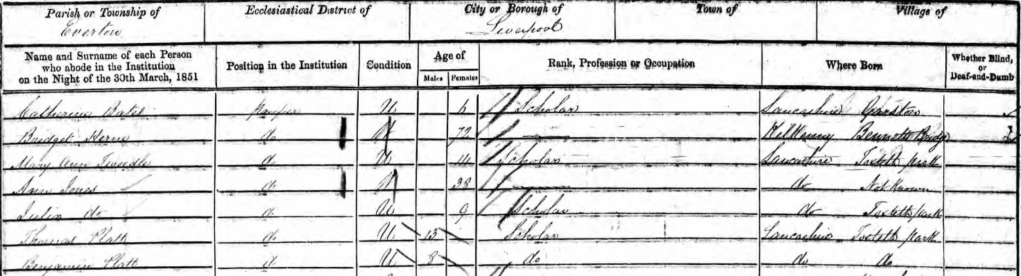
In the year of 1851 brothers Thomas age 13 and Benjamin aged 8 are listed as residing at the West Derby Union Workhouse, Walton on the Hill, Lancashire, England. Both brothers are listed as being paupers and are shown as being scholars, so they were obtaining schooling rather than being sent directly to work like many children during this time.
However life in a workhouse for children has been reported all throughout to have been a cruel and horrible place to live.
As an adult John who would have been 23 at the time is not shown on the same census and at this time I am unable to confirm his location.
What happens next for my family was pinnacle in it’s possible survival and the reason why we proudly call ourselves Australian.
Faced with a bleak future, the cold weather and poverty of Liverpool the three brothers decided at some stage to make a fresh start and emigrate to Australia.
What means they had to emigrate raise many questions of which I am unable to answer based on the available shipping records however in an Australia publication entitled “men of Mark” in which subscribers supplied personal information through paid fee the article of of which Thomas Platt organised, it states;
“He was educated and bred up in his native land, but while still a youth, he saw that there was not much chance of making his way to a good position in old England. He consequently determined to seek his fortune in other lands and when the news of the discovery of gold in Australia arrived in the old country, his attention was attracted to this modern Eldorado. Accordingly, in 1851, he left England to come to New South Wales but at once proceeded to Ballarat (sic) in Victoria, which at that time was the scene of the greatest gold rush”
Between the years of 1851 to 1853 the price of passage from England to Australia was quiet high at approximately 26 pounds per passenger for steerage. Shipping records indicate the 3 brothers all arrived as unassisted passengers, meaning that there passage was not paid by the government, so to obtain this value x 3 would not have been an easy feet taking into consideration that the average wage for an ag labourer was 10 shillings (0.50 pound) per week. Using this math it would take 12 months to cover a single ticket of passage without spending a single cent.
Some Poor Law Unions opted to send destitute children to the British colonies, in particular to Canada and Australia, where it was hoped the fruits of their labour would contribute to the defence of the empire and enable the colonies to buy more British exports. Known as Home Children, the Philanthropic Farm school alone sent more than 1000 boys to the colonies between 1850 and 1871, many of them taken from workhouses. It could be possible that both Thomas and Benjamin were part of this scheme and were willing participants – this would make sense as the three brother arrived on 2 different ships.
Based on the “Men of Mark” I believe that there was a level of interpretation of when Thomas and Benjamin left England. As the shipping records show the brothers did not arrive until 1853, as the gold rush started in 1851 I believe that is when the idea of leaving took place – or the brothers somehow left the workhouse institution and worked independently until being able to afford their passage to Australia.
We do know that from the shipping records Thomas listed himself as a Baker, a trade his younger brother Benjamin was to eventually also take up in Australia. We also know that John had the trade of a master shoe maker.
Life at sea was uncomfortable and often hazardous, particularly for passengers who travelled cheaply in ‘steerage’ (the lowest deck and below the water line). Storms were common in the Southern Ocean, but were not the only danger. Hygiene was poor at the best of times and worse in bad weather. ‘Batten-down the hatches’ meant passengers on the lowest deck were confined without ventilation or light in conditions that were ideal for the spread of disease. The use of candles or oil lanterns was restricted and sometimes forbidden – cramped conditions with timber, straw mattresses, hemp (rope) and tar caulking, meant a fire could spread with terrifying speed. A disaster at sea or shipwreck on the coast left little hope for rescue – few sailors or passengers could swim, and there were rarely enough life-boats for the numbers on board.
For ‘steerage’ passengers in particular, cramped and unhygienic quarters became worse when tremendous storms were encountered in the Southern Ocean. At such times, all passengers were confined below deck for days, sick and tossed around, often in complete darkness, and fearing for their lives.
Thomas Platt (age 15) and Benjamin Platt (age 9) arrived on the ship “The Queen” which departed the docks of Liverpool and arrived into Sydney port in April 1853.

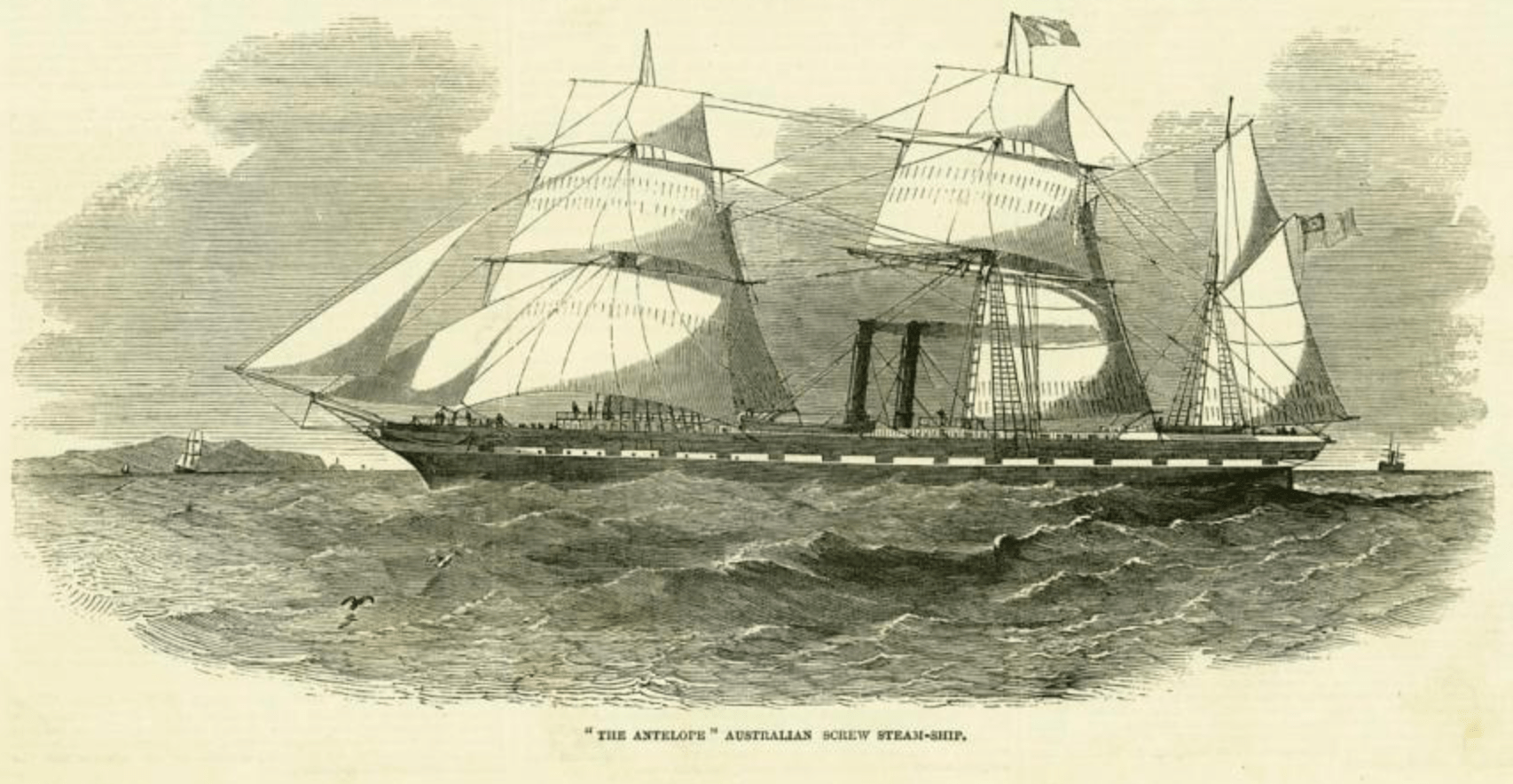
John Platt (age 25) arrived a few months later into Melbourne in August 1853 on the ship called “Antelope” which also departed the docks of Liverpool.

So began their fresh start in a new country.
They now had the opportunity to path their futures away from the coldness and poverty of England.
Further information on the three brothers will be available in future 52 ancestors in 52 weeks challenges as well as highlights in “Stories of our Ancestors” of their success in establishing themselves in their new home of Australia.
Research References :
https://museumsvictoria.com.au/longform/journeys-to-australia/
 Paths of our Life Story
Fantastic! It seems hard to imagine two children traveling, so far, alone. But, I have known one or two teenagers myself who had that sort of fearlessness. I hope the brothers stayed together. I look forward to reading more about them. Thanks for sharing.
LikeLiked by 1 person
Thanks Barb, They certainly did stay together. I haven’t updated much more of the story but plan on doing so soon
LikeLiked by 1 person